

Client:
MoonTech
Project Type:
Educational Web Platform
(B2B/B2C)
Team:
Product Manager, UX Designers, Engineers, Animators, and teachers team
My Role:
UX/UI designer — Research, Concept, Wireframes, Prototyping, Testing, Design System
Background
MoonTech is a non-profit organization that strives to promote science and science education. In April of 2019, MoonTech became the first private entity in history to reach the Moon.
This project aimed to create an engaging learning platform for 8th–9th grade students in Israel, Morocco, and France, most of whom had little to no prior interest in science or space. Teachers were equally important stakeholders, relying on the system to manage lessons and track learning outcomes.

Problem
Many students lack engagement when introduced to unfamiliar subjects, such as space or physics, making it harder to spark their curiosity and participation. At the same time, teachers have limited tools to manage interactive lessons and track student progress effectively.
⚡ Challenge: Designing a cross-cultural digital learning experience for students with no prior interest in science, while meeting teacher needs for structure and evaluation.
Product Goals & Values
-
Make science feel relevant, fun, and exploratory
-
Provide a simple and structured teaching tool
-
Work across cultures and digital literacy levels
-
Integrate video, quizzes, infographics, and games
-
Include basic LMS features for assignments and tracking
User Research
Our research showed that:
-
Teachers valued a clear teaching structure more than “cool” content
-
Students wanted bite-sized, interactive, and playful content
-
Game elements helped with engagement, but needed to be purposeful

Persona 1:
Ilan, Teacher,
38, Israel
Teaches large mixed-level classes. Needs simple tools to plan and deliver lessons.
Pain Points:
-
Lack of time to prepare extra materials
-
Varying digital skills and unfamiliarity with complex interfaces
-
Frustration when tech tools don’t align with curriculum goals
-
Difficulty maintaining student interest in abstract topics

Persona 2:
Elese, Student,
13, France
Sociable, curious, prefers teamwork and narrative-based learning.
Pain Points:
-
Low prior knowledge or interest in space/physics
-
Easily bored by text-heavy, passive content
-
Struggles with abstract or overly theoretical material
-
Limited attention span; needs fast and rewarding interaction

Persona 3:
Ariel, Student,
14, Israel
Quiet and thoughtful. Struggles to focus during traditional lessons but enjoys hands-on activities.
Pain Points:
-
Thinks science is “too hard” or “not for him”
-
Avoids long explanations or static visuals
-
Needs external motivation to stay engaged
-
Loses interest without visible progress or feedback
Market Research
We explored existing platforms for digital learning and classroom management (e.g., Kahoot, Classcraft, Labster, Google Classroom).

We analyzed popular games by examining their core gameplay loops to understand how feedback, reward, and progression systems maintain player attention and build motivation.


Concept
The concept focused on blending educational content with game-inspired mechanics, creating a smooth, motivating user experience for both students and teachers.

Wireframes & Prototyping
Initial wireframes and simple prototypes helped the team validate the idea of straightforward, linear flows. However, due to the specific cognitive needs of our users, effective testing required an almost fully designed interface — only then could we truly observe how users interacted with the experience.

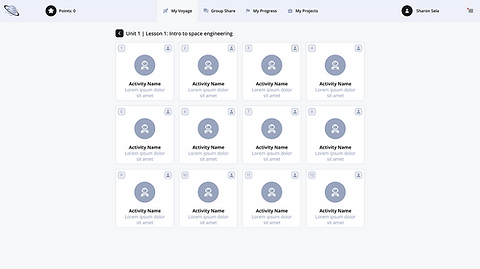
My Voyage | Units
My Voyage | Lessons


My Voyage | Activities
Group Share


LMS
A “Learning Management System” is designed to manage courses, training programs, or any educational program. This LMS is a general solution tailored to various clients with multiple classes and objectives.
I have developed a general scheme and blocks that allow users to make changes effectively.


Testing Insights
We tested early prototypes with teachers and students. Initial feedback was encouraging — students responded well to visual storytelling and interactive tasks, while teachers found the structure supportive for lesson planning.
However, testing also uncovered key usability issues. Some students found it confusing to move between lessons and activities, expecting a more guided experience.
Amir — 9th grade student, Israel
"I wasn’t sure what to do next after the video — do I play the game or go to the next page?"
In response, we restructured the flow to feel more linear and added clearer visual guidance to help users stay oriented.
Final Design
Focused on clarity, friendliness, and cognitive simplicity:
-
Colors: soft pastel palette for emotional safety
-
Typography: large, legible fonts like Fira Sans
-
Icons: minimal detail, easily recognizable shapes
Typography - Open Sans

Character

Colors
#0B1344
#213592
#5587E8
#01B59C
#FA4E61
Icons


Outcomes & My Contribution
Thanks to close collaboration with MoonTech and educators, we created an interactive learning platform that made complex STEM topics accessible and engaging for students.
Key results:
-
Students stayed engaged longer than expected during pilot testing
-
Teachers reported smoother lesson planning and assessment tracking
-
The multilingual platform was well-received in all three countries
-
Approved for next-phase development and real-world implementation
This project showed how thoughtful design can transform a challenging topic into a meaningful and enjoyable experience for both students and teachers.


